Possum Valley Water Supply
There are rainwater tanks at both cottages with a single tap near the sink. I suggest that you use this water for drinking and cooking. Although the tanks are small, they have not yet ever run out.
The water in the rest of the cottage comes from the creek. Being at the top of the Great Dividing Range, we are at the top of the catchment and have first use of the water. Possum Creek starts on the next block and from springs on this block. It is good fresh rainwater filtered through rainforest collecting whatever organic material there may be and is untreated.
The water used to be pumped from Possum Creek using a No.6 Billabong ram pump. Billabong stopped making them

Ram Pump
20 years ago and the pump is probably 30 years older than that. But with a working life of more than a century, I calculate that it will still be serviceable for 30 years longer than I have to worry about. It is situated 80m downstream of Black Bean Cottage. As it makes some noise, like hammering at heartbeat rate, I try to avoid using it when Black Bean is occupied. I need to pump about 1 day a week if it doesn’t rain. Both tanks also collect rainwater. You can start it if that would amuse you. Go down to the pump and push down the only thing that will move (the clapper valve). To stop, hold it up. How easy was that.
The first ram pump was invented by the Montgolfier brothers in 1792 (of hot-air balloon fame). They used a cannonball for the clapper valve and running up a curve in the pipe to be stopped by a narrowing of the pipe. Cannonballs not so easy to obtain nowadays. This high-tech device requires no power, using the fall of the creek to drive a water hammer effect. Suddenly stopping the flow of water in the drive pipe causes a pressure spike from the momentum of the water. Whilst the pressure spike is higher than the delivery pressure in the dome, water is forced through a one-way valve, which is a disc of rubber over a plug hole. A recoil effect restarts the cycle.
Using a fall of 3m, it can pump first to the tank by the games room at 22m head. When that tank is full, a ball cock shuts off and the water goes to a tank above Maple Cottage at 55m head. It can pump about 4000 litres a day to the top tank and more to the lower tank.
Next best thing to perpetual motion. It has been left in place as a museum piece and I have abandoned it’s maintainence.
New Pump
A couple of years ago I was having difficulties sealing the old rusted drive pipe of steel to withstand the pressure spike of the shock wave. The pipes are about 75mm in diameter and 6m long and very heavy. They corrode through with pit corrosion especially at the ends of the pipes. I need two meter long pipe wrenches to unscrew them and I can barely drag the pipes. The only way to move the pump is to dismantle it as I can’t get a crane or other lifting device anywhere near it. So I decided I am definitely not getting any stronger, and I won’t be able to repair or replace the parts any longer. I happened to find a flyer of a different type of water-driven pump that a guest had left in Maple Cottage. It is called a “Bunyip” pump and cunningly designed using a car tyre to
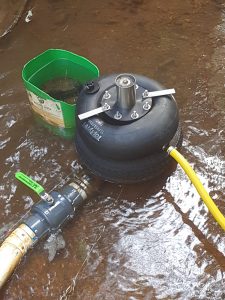
pump at rest
expand from low pressure water to drive a cylinder up and down over a fixed piston producing high pressure water for the delivery pipe and the tanks up the hills. The dry weight of the pump is just 17 kgs which is a delight after trying to manhandle the cast iron ram pump. The drive pipes are standard plastic downfall pipes and a tiny fraction of the weight and cost of steel pipes. Also the Bunyip pump will work on any input flow rate and is untroubled by bubbles in the drive pipe. It also pumps about twice the water volume per day and up to 8000 liters per day to the top tank. The pump is tailored to suit the head required at any site by selecting the cylinder size. It is much quieter than a ram pump and just makes a gentle woosh sound. The inventor and manufacturer of the pump lives near Innisfail. Brett Porta 0427 631 819. Website www.portasaffordablepumps.com.au
The pump can work with as little as half a meter of head but I am fortunate enough to have 4m of head. It sits in the water and draws the water from the bucket at the side. On the top is an innertube filled with water to increase weight as I have a high head. Underneath is a car tyre which is expanded by the drive pipe to lift the top part and the cylinder. The piston is fixed to the bottom. At the end of the pumping stroke a seal parts and the water in the tyre is discharged. I adjust the inlet ball valve so that the stroke cycle is about 30 per minute. I can recommend this pump design.